
Armstrong Millworks
Highland's family hardwood mill, with its whole molding library online
armstrongmillworks.comA new website for a family hardwood mill in Highland, live eight days after the agreement was signed. Every one of its 2,068 molding profiles has its own page, with a drawing that prints at actual size, beside a lumber list of more than 50 woods and a CMS the shop can keep up to date itself.


Responsive Design
Every screen
Case Study
About the project
The mill
Armstrong Millworks is a hardwood mill and custom molding shop on the Armstrong family farm in Highland, Michigan. Roland Armstrong and his son Howard, dairy farmers on the family's land, started it together in 1948, and it is still on that same land today. Dennis and Adam Armstrong run it now, carrying the family business into its fourth generation. The mill carries many domestic hardwoods and around 20 exotics, mills boards to order, and runs moldings from a library of knives built up over decades.
Less than three weeks, first email to launch
In October, GoDaddy emailed Adam that it was retiring part of the Windows hosting his website ran on, on November 10, and listed his site as affected. He wrote to me on October 16. Adam and I went through a working demo on a call on the 22nd, he signed the agreement on the 28th, and the new site went live on Thursday, November 5: eight days later, a day ahead of the planned launch, and five days ahead of GoDaddy's date.
Fast is not the same as rushed. The design was settled before the build began, on a demo Adam could click through, and the build started the afternoon he said yes. Every molding was imported by script rather than retyped, and profiles missing from the old site's public pages were recovered from a full backup of its server. Adam's changes came in four rounds, each tried on the test site before it went live. Before launch I checked the new site against the old one, down to each wood's thicknesses and every press clipping, had the live server built and tested three days ahead, and on launch morning sent a real message through the form to make sure it reached Adam's inbox.
A molding library you can search
Most people come looking for the mill with a piece of trim in hand, needing to find, or make, the molding that matches it. So the library is the heart of the site. Each profile has its own page with its size, type, knife numbers and a drawing of the shape. The library searches as you type, by knife number or type, and filters by width, so "crown, about three inches" becomes a short list in a few taps. Each of the 22 types has its own page too, listed in the order the shop keeps similar shapes together.
Matching comes down to holding the profile against the trim. The site makes each drawing from the profile's PDF, sized in real inches, and every profile page has a Print actual size button. In my checks, printed drawings came out within 1/32 of an inch of the listed size. Every knife the shop has had made is still on the shelf and never reground to another shape, the site says so, and when a molding is not in the library it explains that a new knife can be made to match.
Every old address still works
The old website listed every molding as a PDF. Each old PDF and picture address now goes straight to its profile's page in one step, and the old site's pages go to their new counterparts, so a bookmark or a link from before the launch still lands in the right place.
The lumber list and the milling
The Lumber & Milling page lists more than 50 woods, domestic and exotic, with the thicknesses each one comes in, under a box at the top for what is hard to find and in stock now. Milling is written out machine by machine (planing, sanding, resawing and surface jointing), with the widths each one takes and what it costs. The page also covers what else the mill makes and sells, from glue-ups and stair parts to kiln-dried shavings for horse stalls, and how custom orders, deposits and pickup work.
Seventy-plus years, from the family scrapbook
The Our Story page is a timeline from the family's arrival in Highland in 1842 to Dennis and Adam today, and each entry names the newspaper story or family record it comes from. As The Detroit News reported in 1991, the mill supplied hard maple for NASA's Lunar Rover and wood for a Paul McCartney guitar, and later stories add a table for Air Force One. All eight press clippings from the old site open in full, beside three videos of the mill.
Barn red, on every screen
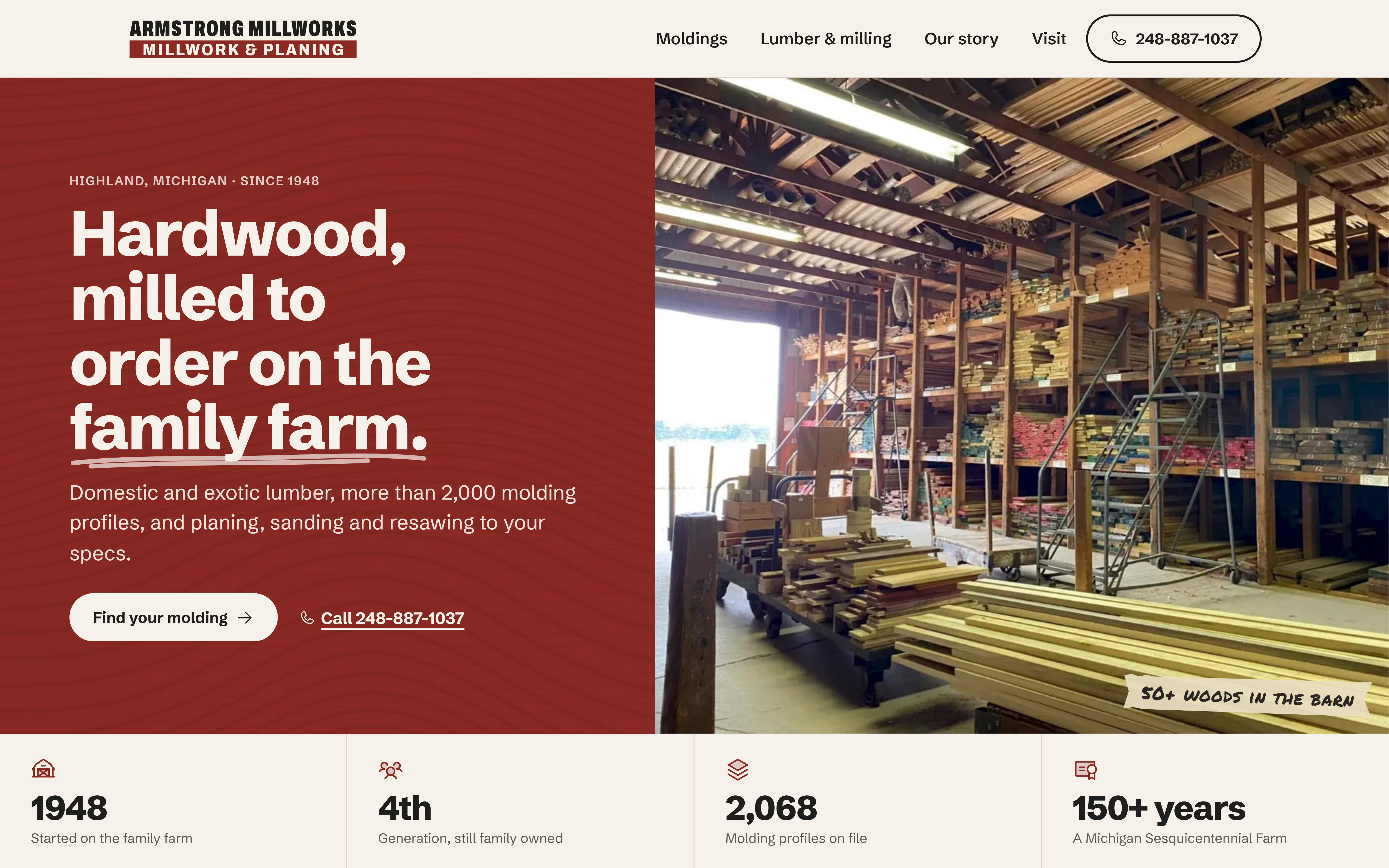
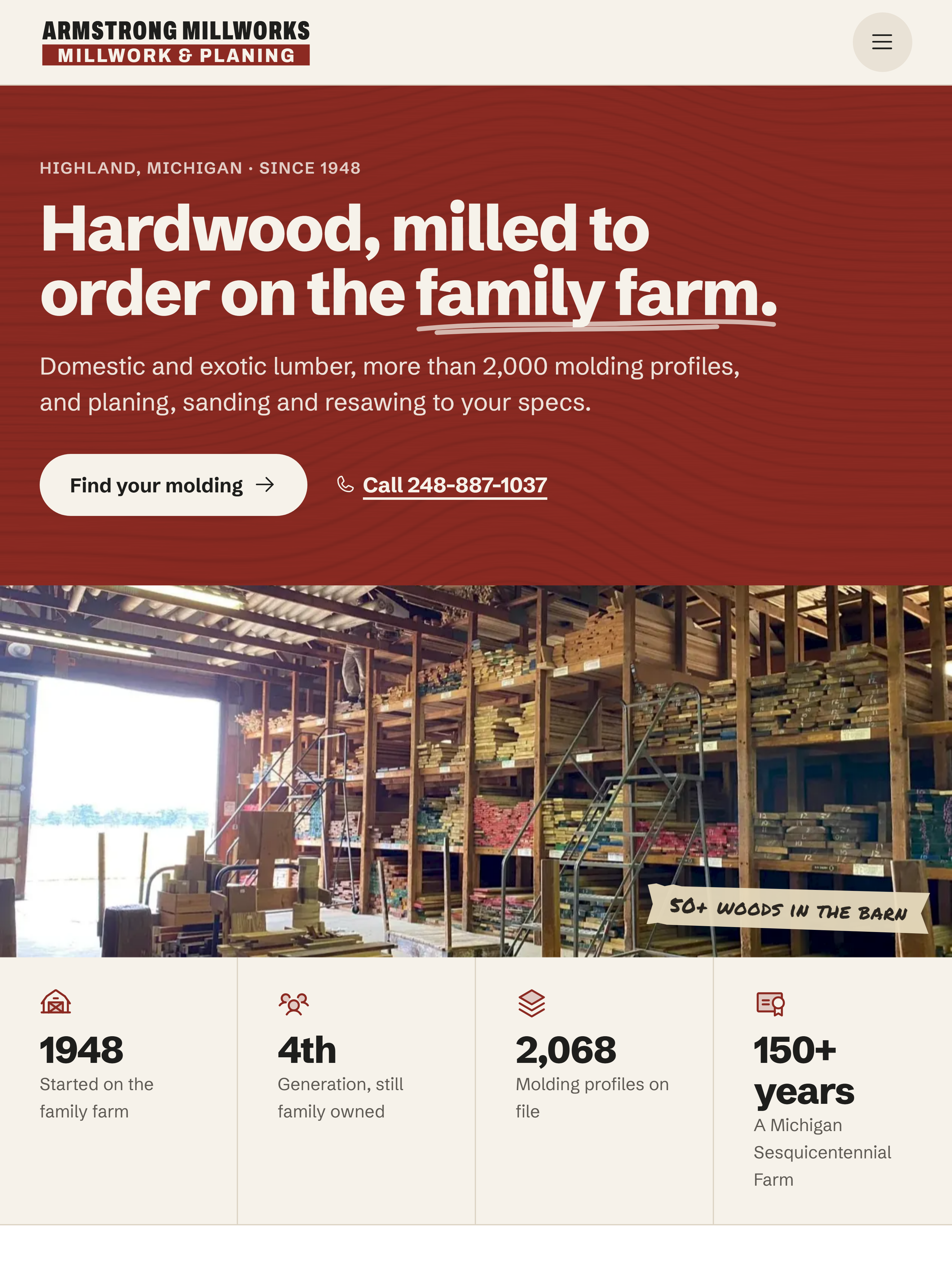
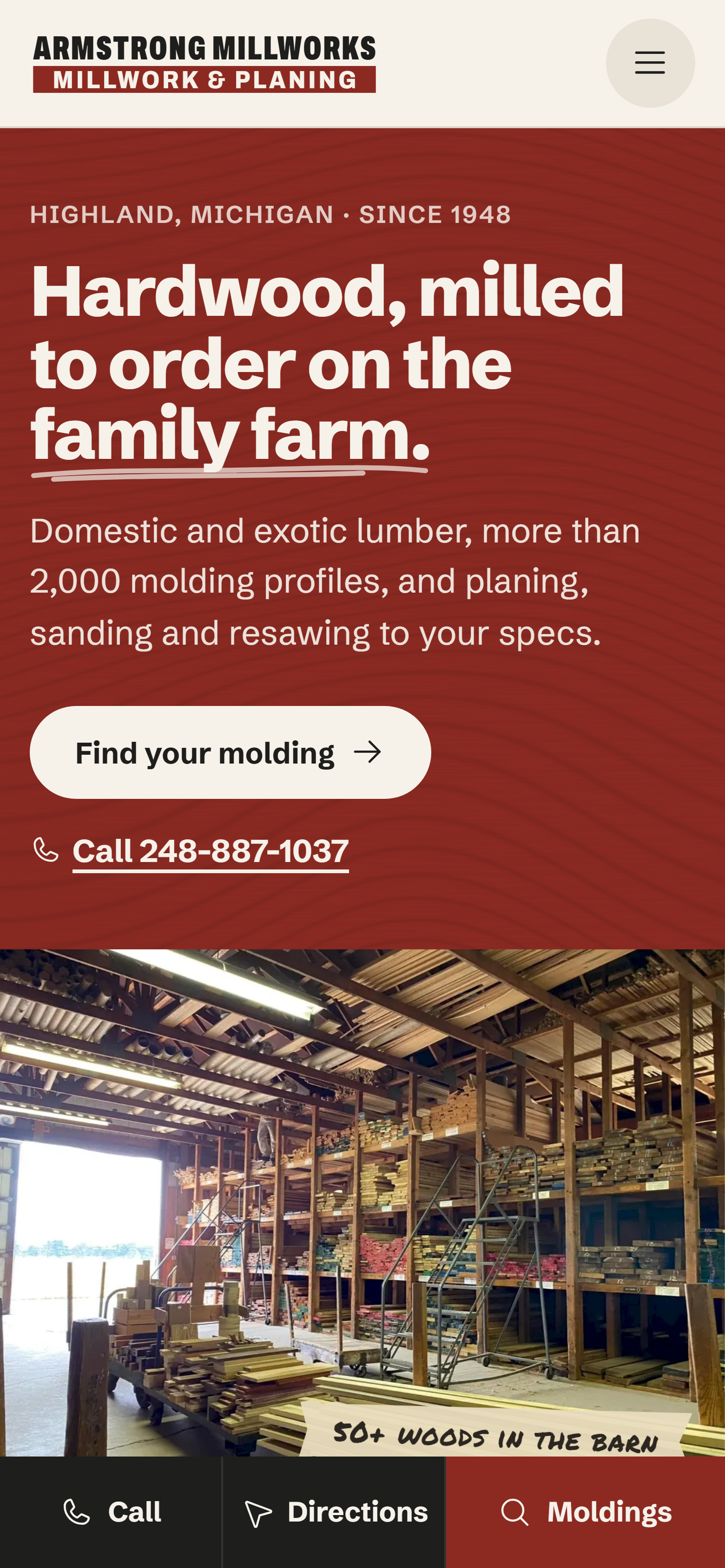
The design is the Barn Red direction Adam approved from that demo: a barn-red panel beside a photo of the lumber racks, cream and charcoal, labels written in marker on masking tape across the photos, and a pencil underline under one word in each heading. It is built mobile-first, and on a phone a bar along the bottom of the screen keeps Call, Directions and Moldings one tap away. Customers often call just to check the hours, so the site answers that itself: it shows whether the mill is open right now, worked out from the shop hours and a list of closed dates, and a holiday closing goes in a notice at the top of every page. The Visit page adds directions, a photo of the roadside sign to look for on M-59, answers about ordering and payment, and a short form that takes a photo of the trim a customer wants matched.
Like every site I build, it is custom from the ground up: hand-written CSS and vanilla JavaScript, no page builder theme.
A CMS the shop can run itself
Adding a profile is one form: the knife number, the type, the thickness and width, and the PDF the shop already makes for each profile. The site draws the shape from the PDF and lists the new profile right after the one picked in "Show it next to," so the type pages stay in the shop's order. The lumber is just as plain: the in-stock box is the first thing in the Lumber page's editor, and the species lists are one wood per line with its thicknesses. Every other line a visitor reads can be edited too, in tabs that follow the page from top to bottom, and Site Settings holds the hours, the closed dates and the holiday notice. The start screen shows the hours and how many items are in the in-stock box, with a link to edit it, counts new form messages, finds a profile by knife number, and carries a website report that will also be emailed on the first of each month, starting in December.
Results
The outcome
The site went live on Thursday, November 5, 2026, eight days after the agreement was signed and five days before GoDaddy's date. Every old page, profile PDF and picture address redirects to its new page.
It launched with Google Analytics counting what matters to a mill: calls, directions, form messages, molding searches and printed profiles, with Search Console connected, a sitemap and structured data for the business and every breadcrumb trail.
On search and new customers, it is too early to say. Google is still catching up with the new addresses. I will publish what the numbers show once there is enough of them to mean something.